Costs follow WI
2%
Hypothetical cost share. Expenses still come out of the owner’s account at this percentage.

Working interest
A working interest is participation in an operating asset: a share of development and operating costs, and an entitlement to production revenue after royalty. Its value depends on the wells, the price paid, the contracts, and the owner’s tax position — not on tax treatment alone.
Working interest (WI) usually determines the share of qualifying project costs. Net revenue interest (NRI) determines the share of production revenue after royalty and similar burdens. These percentages are often different. Contract provisions, carried interests, and changes after payout can alter the allocation.
Costs follow WI
2%
Hypothetical cost share. Expenses still come out of the owner’s account at this percentage.
Revenue follows NRI
1.5%
Hypothetical: 2% WI × (1 − 25% royalty) = 1.5% NRI, with no other burdens. A 2% working interest does not mean 2% of gross sales reaches the owner.
Hypothetical illustration. Always ask for both percentages and the contract supporting them.
| Investment type | Main exposure | Distinction |
|---|---|---|
| Working interest | Well revenue and operating costs | May require additional capital and can carry liability |
| Mineral or royalty | Lease payments or production royalties | Usually does not fund drilling |
| Public energy stock | Company or portfolio value | Shareholders do not directly receive a well’s IDC deduction |
| Private partnership | Contractual share of pooled assets | Ownership, fees, reporting, and tax treatment vary |
The operator manages field activity. A sponsor may source interests and administer the investment entity. Those are different roles. An operator’s reputation does not guarantee production, tax treatment, distributions, or resale value.
First production, first sale, purchaser payment, and an investor distribution are separate events. A stated distribution date is a forecast until supported by actual receipts.
01
Acquisition and planning
02
Drilling
03
Completion
04
First sales
05
Operating period
06
Sale or abandonment
A drilled but uncompleted well (DUC) has already been drilled but still requires completion before normal production. A producing acquisition provides historical operating data, but its purchase price reflects that information and future output remains uncertain.

Begin with product volumes multiplied by realized prices. Apply NRI, then subtract allocated operating expenses and applicable production taxes. Then account for entity expenses and reserves. Oil, gas, and natural gas liquids have different markets; a gas-heavy project should not be modeled using oil prices.
| Hypothetical monthly calculation | Amount |
|---|---|
| Gross property sales | $100,000 |
| Owner revenue at 1.5% NRI | $1,500 |
| Operating costs $20,000 × 2% WI | ($400) |
| Illustrative production taxes | ($100) |
| Illustrative entity expenses and reserves | ($100) |
| Cash available before owner income tax | $900 |
Arithmetic illustration, not a forecast or an industry average. Do not annualize $900 into a promised yield. Holding deductions fixed, a 20% decline in gross sales reduces owner revenue from $1,500 to $1,200 and available cash from $900 to $600 — a 33.3% decrease.
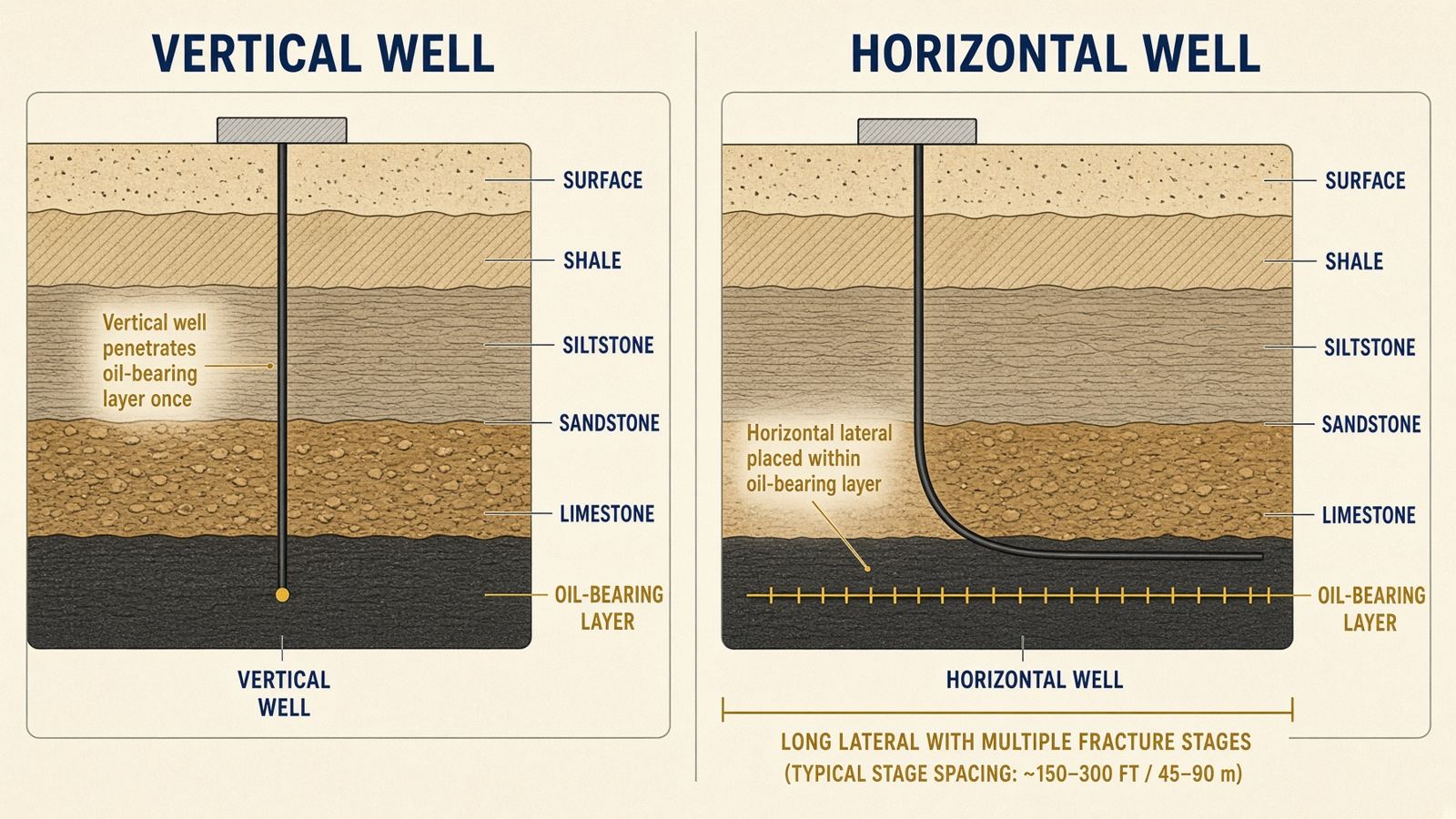
Vertical
A vertical well generally crosses a formation through a relatively short interval. Individual wells vary substantially.

Horizontal
A horizontal well turns within the formation. Hydraulic fracturing is a completion technique, distinct from drilling direction. Horizontal wells can produce strongly early and then decline.